
Article 1: The Digital Nation We Are Building
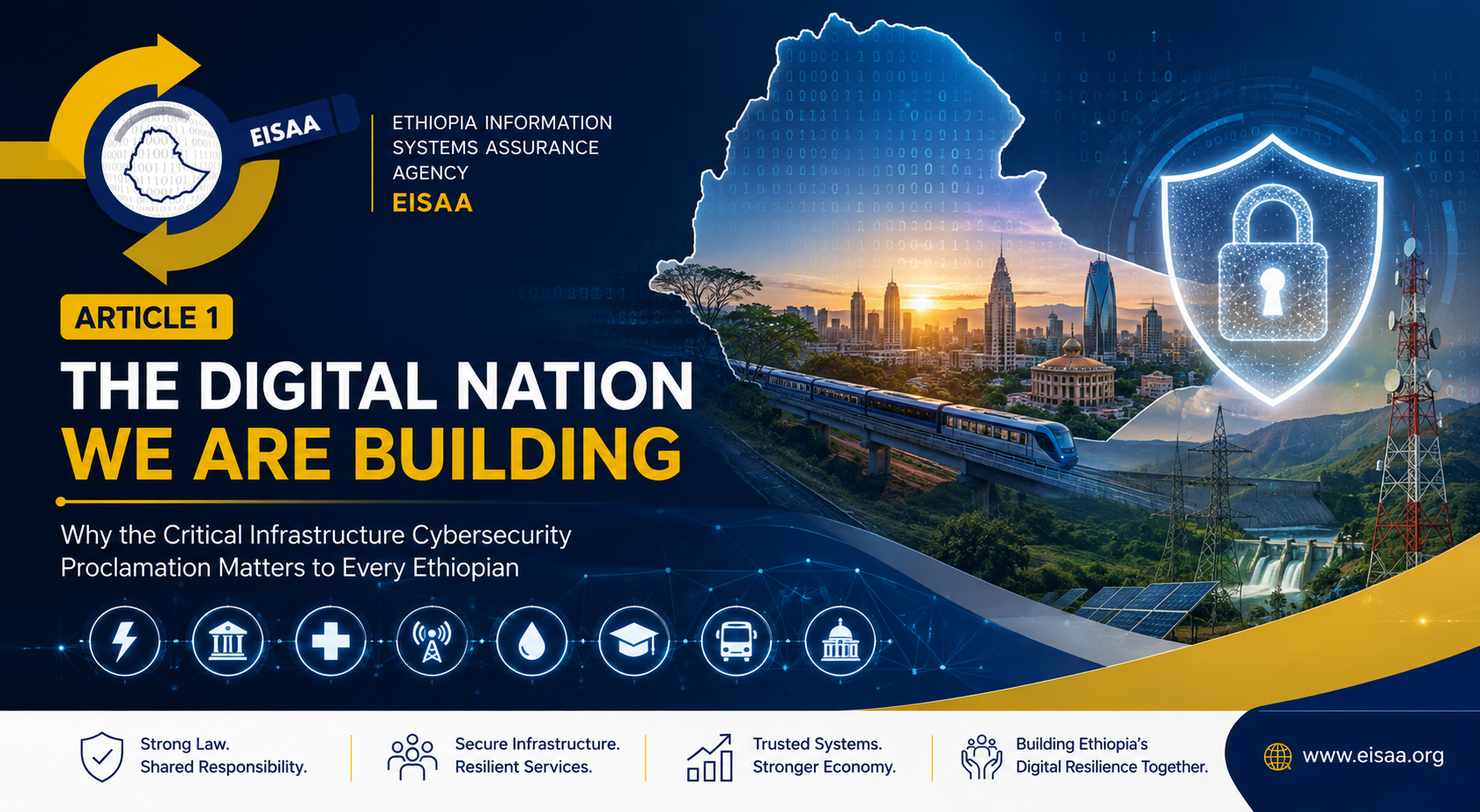
“Cybersecurity is not about protecting computers. It is about protecting the way a nation lives.”
Every morning, millions of Ethiopians begin their day without thinking about cybersecurity. They switch on the lights, make a phone call, withdraw money from an ATM, pay with mobile banking, visit a hospital, attend school, or use an online government service. These activities have become so common that we rarely stop to think about the technology working quietly behind them.
We simply expect everything to work. But imagine a different morning.
Imagine hospitals losing access to patient records. Banks unable to process payments. Mobile networks becoming unavailable. Electricity providers struggling to operate their systems. Airports delaying flights because critical systems are offline. Government services becoming inaccessible. Businesses unable to communicate with customers.
This is no longer just an information technology problem. It quickly becomes an economic problem, a public safety problem, a healthcare problem, and ultimately a national security problem.
This is the world we now live in.
As countries become more digital, they also become more dependent on digital infrastructure. The systems that support our daily lives are increasingly connected. A disruption in one important sector can quickly affect many others. An attack against one organization may spread across an entire supply chain. A cyber incident that begins with a single computer can eventually interrupt services used by millions of people.
For many years, cybersecurity was seen as the responsibility of information technology departments. Organizations bought firewalls, installed antivirus software, and believed they were protected. That way of thinking no longer reflects today’s reality.
Today, cybersecurity is about keeping hospitals treating patients, banks serving customers, electricity reaching homes, water flowing to communities, businesses operating, and governments continuing to provide essential public services.
In other words, cybersecurity has become part of everyday life. This is why the conversation about cybersecurity must also change.
We should no longer ask only, “How do we protect our computers?” Instead, we should ask, “How do we protect the services that our society depends on every day?”
That question is at the heart of Ethiopia’s Critical Infrastructure Cybersecurity Proclamation No. 1426/2026.
The proclamation recognizes that cyberattacks against critical infrastructure can affect the country’s economy, national security, peace, social stability, sovereignty, and the information systems that support them. It also recognizes the growing cyber risks facing these infrastructures and calls for coordinated protection, clear responsibilities, information sharing, and long-term national capability.
This is an important shift in thinking.
The proclamation is not simply introducing new legal requirements. It is recognizing that Ethiopia’s digital future depends on protecting the systems that support the country itself.
That future includes government services delivered online. It includes modern banking. It includes digital healthcare. It includes telecommunications, transportation, education, agriculture, energy, manufacturing, and many other sectors that increasingly depend on information technology.
The accompanying operational blueprint illustrates this wider picture by identifying twelve broad areas of critical infrastructure, ranging from finance and government services to health, energy, transport, education, communications, agriculture, industry, and disaster management. Together, these sectors form the foundation of a modern digital nation.
Many people hear the words critical infrastructure and immediately think about military facilities or government buildings. In reality, critical infrastructure is much broader.
- A hospital can be critical infrastructure.
- A telecommunications company can be critical infrastructure.
- A payment network can be critical infrastructure.
- An electricity provider can be critical infrastructure.
- Even organizations that are privately owned may become nationally important if their services are essential to the daily life of citizens.
This is one of the most important ideas introduced by the proclamation. The protection of critical infrastructure is not only the responsibility of government. It is a shared national responsibility involving public institutions, private organizations, infrastructure owners, technology providers, universities, and cybersecurity professionals.
No single organization can protect the country alone. At the same time, no organization operates in isolation.
Our digital systems are connected. Our economies are connected. Our services are connected.
Because they are connected, their security must also be connected.
Around the world, countries have reached the same conclusion. Building a secure digital nation requires cooperation rather than isolated efforts. Laws provide direction, but real protection comes from people working together, sharing information, improving their capabilities, and preparing for incidents before they happen.
This is why the proclamation should not be viewed simply as a compliance requirement. It should be seen as an opportunity. An opportunity to strengthen trust in digital services. An opportunity to improve business continuity. An opportunity to build national cybersecurity expertise. An opportunity to encourage cooperation between government and the private sector. An opportunity to prepare Ethiopia for a future where digital services will become even more important than they are today.
Of course, passing a law does not immediately create resilience. A proclamation cannot stop a cyberattack by itself. Real resilience is built over time. It requires leadership, skilled professionals, investment, continuous learning, strong institutions, and cooperation across many sectors. It also requires organizations to move beyond thinking about cybersecurity as a technical issue and begin treating it as a strategic responsibility that affects every part of their business.
The publication of the proclamation is therefore not the end of the journey. It is the beginning. Like constructing a house, the first step is laying a strong foundation. The proclamation provides that foundation. The structure that will stand on it depends on how well government, critical infrastructure owners, private industry, universities, and professionals work together in the years ahead.
The success of this proclamation will not be measured by the number of regulations that are written or the number of audits that are conducted. It will be measured by something much more important: whether Ethiopia can continue delivering essential services safely and reliably, even when facing increasingly complex cyber threats. That is the true meaning of digital resilience.
In my next article, we will explore what digital resilience really means. Is cybersecurity simply about following rules and passing audits, or is it about building organizations that can continue operating even when things go wrong? Understanding that difference is the key to understanding why compliance is only the beginning, not the destination.

